
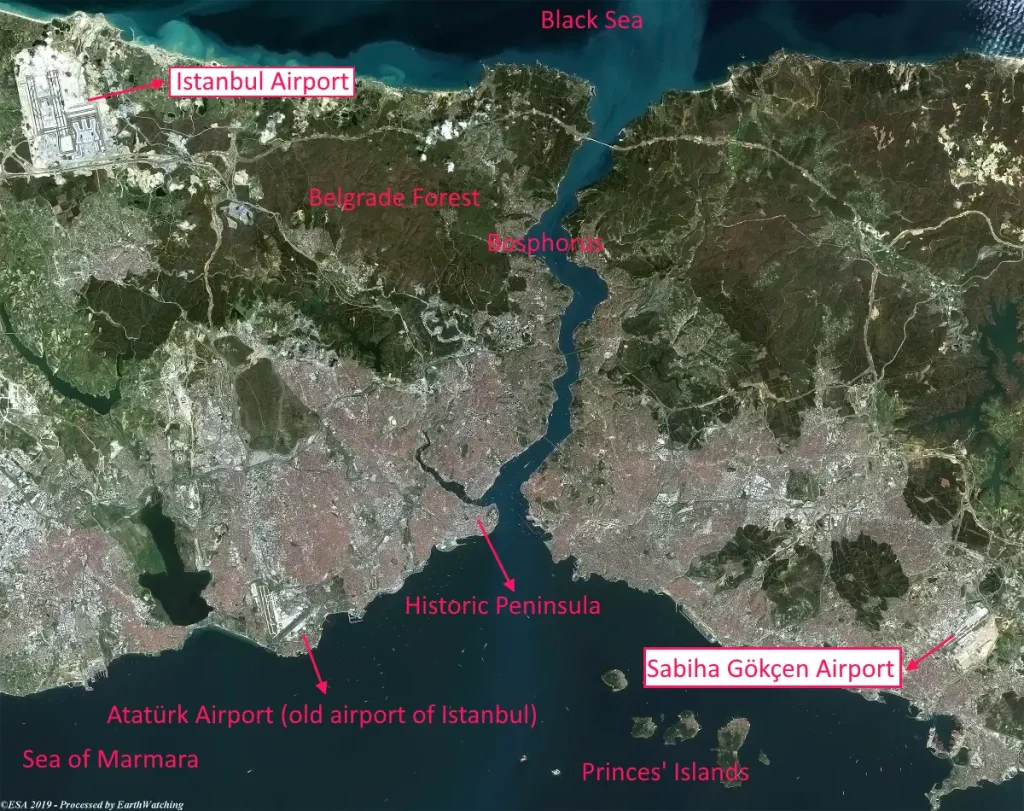
Istanbul is famously known as the “City on the Seven Hills” (Yedi Tepeli Şehir in Turkish), a title inherited from Byzantine Constantinople. Like ancient Rome, Constantinople was traditionally regarded as a city built on seven hills, reflecting its historical connection to the Roman Empire (Rome is also known as the “City of Seven Hills”, Urbs Septicollis in Latin). However, these seven hills are all located within Istanbul’s Historic Peninsula, the heart of the ancient city, bounded by the Golden Horn, the Sea of Marmara, and the old city walls. The Historic Peninsula represents only a small part of modern-day metropolitan Istanbul, which now stretches across a vast area on both the European and Asian sides of the Bosphorus.
The Seven Hills of Istanbul: From Byzantium to the Ottoman Empire

The seven historic hills of Istanbul are located within the Historic Peninsula, the area enclosed by the ancient Walls of Constantinople. The peninsula is bordered by the Golden Horn to the north, the Bosphorus to the east, and the Sea of Marmara to the south.
The hills and valleys developed through geological processes over millions of years. Erosion by rivers and streams, changes in sea level, and the geological evolution of the Bosphorus and Golden Horn gradually shaped the landscape we see today. The hills are therefore natural geographical features that existed long before the founding of Byzantium.
The original settlement of Byzantium occupied the eastern end of the peninsula. Following the establishment of Constantinople as the Roman Empire’s new capital in AD 330, the city expanded westward. The construction of the Theodosian Walls in the early fifth century enclosed a much larger area, including the elevations traditionally identified as the seven hills.
During the Byzantine period, prominent locations on these hills became sites for important churches, palaces, and public buildings. Hagia Sophia stands on the first hill, while the now-lost Church of the Holy Apostles occupied the fourth.

After the Ottoman conquest in 1453, monumental mosques and religious complexes continued to shape the city’s skyline. The Fatih Mosque was built on the former site of the Church of the Holy Apostles, while the Süleymaniye Mosque rose on the third hill. These buildings helped preserve the historical and symbolic importance of the seven hills through successive empires.
Locations of the Seven Hills of Istanbul
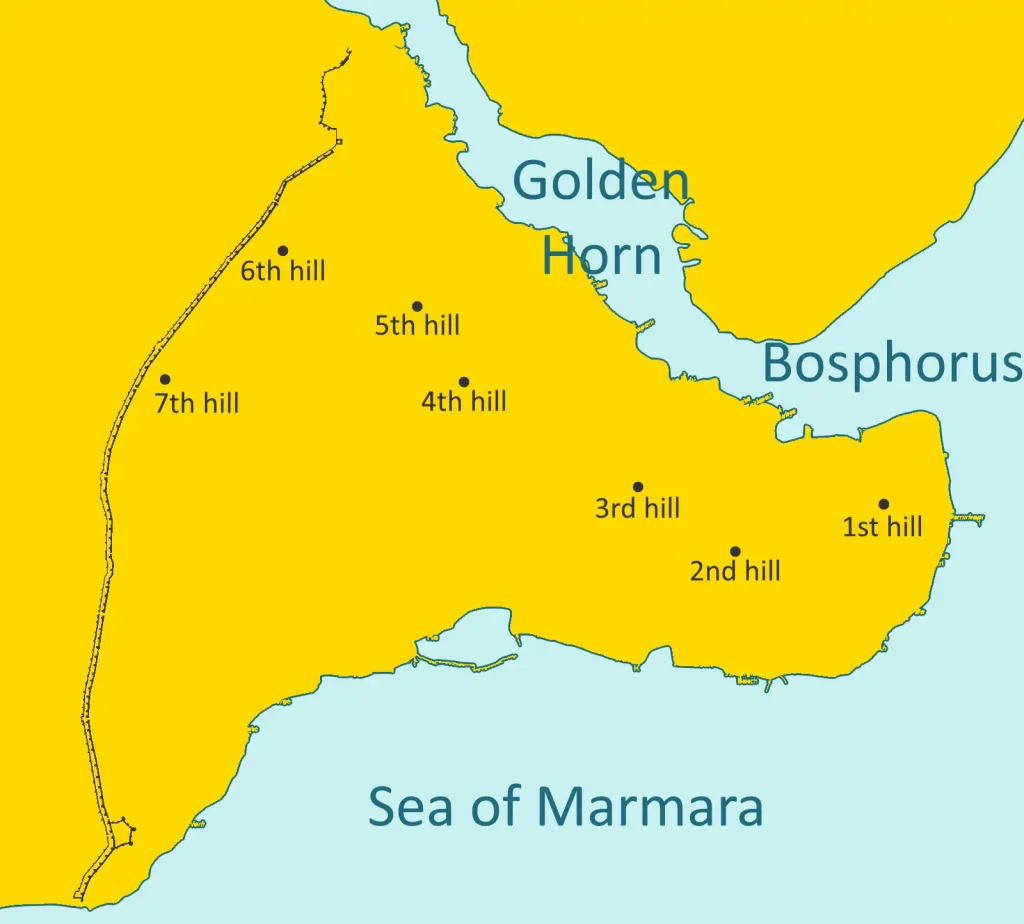
All seven hills are located within Istanbul’s Historic Peninsula, corresponding to the old walled city of Constantinople. Each hill is traditionally associated with important Byzantine and Ottoman landmarks.
1. First Hill: Sarayburnu [Sultanahmet]
The easternmost hill, where ancient Byzantium was founded, extends from Seraglio Point (Sarayburnu) through Sultanahmet. Its major landmarks include Hagia Sophia, Topkapı Palace, the Blue Mosque, and the ancient Hippodrome.
2. Second Hill: Çemberlitaş
Located west of the first hill, this elevation is home to the Column of Constantine (Çemberlitaş), Nuruosmaniye Mosque, and the Grand Bazaar. The column marks the former Forum of Constantine, one of the city’s important Roman public spaces.
3. Third Hill: Beyazıt and Süleymaniye
This hill contains Süleymaniye Mosque, Beyazıt Mosque, and Istanbul University’s historic main campus. Its northern slopes descend toward the Golden Horn, while its southern slopes extend toward Kumkapı and the Sea of Marmara.
4. Fourth Hill: Fatih
The fourth hill is dominated by Fatih Mosque, built on the site of the Byzantine Church of the Holy Apostles. The hill slopes steeply toward the Golden Horn and more gently southward toward Aksaray.
5. Fifth Hill: Yavuz Selim
Overlooking the Golden Horn, the fifth hill is crowned by Yavuz Sultan Selim Mosque. Located above the neighborhoods of Fener and Balat, it is separated from the sixth hill by a valley descending toward the Golden Horn.
6. Sixth Hill: Edirnekapı
Located near the historic land walls, the sixth hill is associated with Edirnekapı and the Mihrimah Sultan Mosque. It is traditionally regarded as the highest of the seven hills and overlooks the western sections of the Historic Peninsula.
7. Seventh Hill: Kocamustafapaşa [Xerolophos]
Known in Byzantine times as Xerolophos, meaning “Dry Hill,” the seventh hill covers a broad area extending from Aksaray toward Yedikule and the Theodosian Walls. Important landmarks include the Haseki Complex, Cerrahpaşa Mosque, and the remains of the Column of Arcadius. The former Lycus stream valley separates it from the hills to the north.
Why Seven? The Symbolism Behind Istanbul’s Seven Hills
The seven hills of Istanbul are not simply a matter of geography. The number seven also carries historical and symbolic significance, closely connected to Constantinople’s relationship with ancient Rome.
The widespread claim that Constantine deliberately established a city on seven hills, exactly like Rome, is not firmly supported by the historical evidence.
As mentioned above, Rome was also famously known as the City of Seven Hills. When Emperor Constantine established Constantinople as the Roman Empire’s new capital in AD 330, the city adopted many of Rome’s imperial traditions. However, the popular belief that Constantine deliberately built his new capital on exactly seven hills is historically questionable.
In a 2023 study, From Byzantion to Constantinople to Istanbul: Historico-Geographical Mapping as Urban Imagination, historian Sinan Tankut Gülhan explains that Constantine’s original city covered only four of the traditionally identified seven hills. The city expanded westward, and the construction of the Theodosian Walls in the fifth century eventually enclosed the larger area associated with all seven.
Other historians have questioned how early the seven-hills tradition actually appeared. In his 2003 study, historian Wolfram Brandes argues that the association with seven hills does not appear in surviving written sources until the late seventh century, and that the familiar classification of seven distinct hills developed much later.
This does not mean that Istanbul’s hills are imaginary. The Historic Peninsula has a naturally uneven landscape, with numerous elevations and valleys. However, identifying exactly seven distinct hills is as much a historical and cultural tradition as a geographical classification.
Over the centuries, monumental churches, mosques, and palaces built on prominent elevations reinforced this symbolic identity, helping establish the seven hills as one of Istanbul’s most recognizable historical characteristics.

Sources
- Seven Hills of Istanbul on Wikipedia
- Seven Hills of Rome on Wikipedia
- The Geology and Geomorphology of İstanbul. Sengor, C; Kındap, T. ITU (Istanbul Technical University) Research website.
- Historic Areas of Istanbul on the UNESCO website
- “Istanbul on Seven Hills” on the Fatih Municipality website
- Study: Knowledge on the Move – From Byzantion to Constantinople to Istanbul: Historico-Geographical Mapping as Urban Imagination. Roy, A.; Gülhan, S. T.; Bazuń, D.; Kwiatkowski, M. https://knowledge.lancashire.ac.uk/id/eprint/48078/1/SoMoveEd-Knowledge-on-the-move-ebook.pdf
- Study: Seven Hills – The imaginary topography of Constantinople between apocalyptic thinking and modern science. Brandes, W. Link
