
Few stories capture the imagination of Istanbul as powerfully as the tale of Hezarfen Ahmet Çelebi (or Hezârfen Ahmed Çelebi), the man said to have flown across the Bosphorus in the 17th century. According to the legend, Hezarfen launched himself from Galata Tower, glided over the waters separating Europe and Asia, and landed safely in Üsküdar.
It is a story repeated in schoolbooks, documentaries, and popular culture, often presented as an early triumph of science and daring. But did it really happen? Or is it a beautifully constructed myth layered over a much smaller historical event?
Let’s examine the story in depth: separating legend from evidence, looking at the historical source, the scientific feasibility, and why the story still matters today.
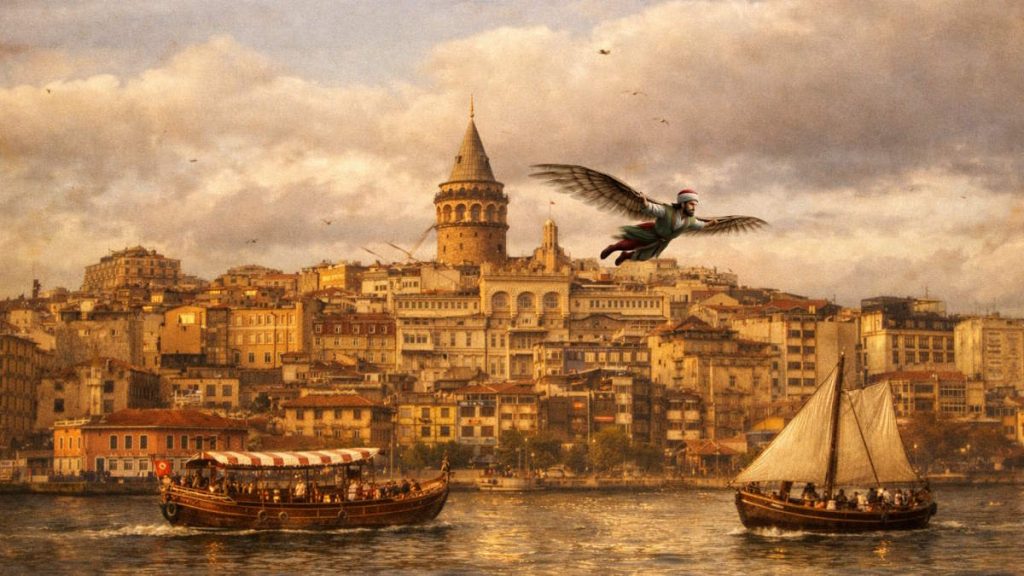
Who was Hezarfen Ahmet Çelebi?
Hezarfen Ahmet Çelebi (or Hezârfen Ahmed Çelebi) was a 17th century Ottoman figure from Istanbul whose fame rests almost entirely on a single account recorded by the traveler Evliya Çelebi. According to this narrative, Ahmed Çelebi allegedly performed a sustained, unpowered flight using artificial wings, launching from Galata Tower and crossing the Bosphorus. No contemporary technical description, independent corroboration, or physical evidence of such a device has survived, and the claim is therefore regarded by modern historians and aerodynamicists as legendary rather than demonstrably historical.
The name Hezârfen is an honorific rather than a personal or scholarly title. It was bestowed by Evliya Çelebi and derives from the Persian hezār meaning “a thousand” and fann meaning “science” or “skill”, together implying “a man of a thousand sciences”. While the title suggests broad intellectual curiosity, it does not imply formal scientific training in the modern sense and should be understood as part of Evliya Çelebi’s literary style, which often blends observation with embellishment.
Today, Ahmed Çelebi’s name survives in modern aviation primarily through İstanbul Hezarfen Airport, a general aviation and flight training airport located in the Çatalca district, about 50 kilometers west of Istanbul, which has operated since 1992 and was named after Hezarfen Ahmed Çelebi in reference to his infamous flight legend.
The Only Source: Evliya Çelebi
Everything we know about Hezarfen’s flight comes from a single man: Evliya Çelebi, the great Ottoman traveler and chronicler. In his monumental 17th century work, Seyahatname (Book of Travels), Evliya describes an extraordinary event during the reign of Sultan Murad IV.
According to Evliya, Hezarfen Ahmet Çelebi studied the flight of birds, built artificial wings, tested them repeatedly, and finally launched himself from Galata Tower. Using favorable winds, he supposedly crossed the Bosphorus and landed in Üsküdar, astonishing the people of Istanbul.
Evliya adds a dramatic twist: the Sultan initially rewarded Hezarfen but later became uneasy. A man capable of flight, Evliya suggests, was too dangerous to keep nearby. As a result, Hezarfen was exiled to North Africa, where he eventually died.
This narrative is vivid, cinematic, and unforgettable. But it raises a crucial question.
Why does no other source mention it?
Why Historians Are Skeptical
Modern historians approach the Hezarfen story with great caution, not because they dismiss Ottoman achievements, but because historical method demands corroboration.
One Source Is Not Enough
There are no court records, no imperial decrees, no foreign observers, and no other Ottoman chroniclers who mention a man flying across the Bosphorus. This is striking. Istanbul in the 17th century was full of diplomats, merchants, and travelers from Europe. A successful human flight across one of the world’s busiest waterways would almost certainly have been recorded elsewhere.
The silence of other sources does not prove the story is false, but it makes the full version highly doubtful.
Evliya Çelebi’s Narrative Style
Evliya Çelebi was a remarkable observer, but he was also a storyteller. His Seyahatname mixes careful ethnography with humor, exaggeration, symbolism, and folklore. He describes giants, prophetic dreams, and supernatural events alongside accurate architectural and social details.
Most historians agree on this point: Evliya should be read critically, not literally. One should take everything he says with a pinch of salt.
That does not mean he invented everything. It means he often expanded real events into legendary ones.
The Physics of the Flight
To evaluate the story properly, we must also consider the science.
The distance from Galata Tower to the Üsküdar shoreline is roughly 3 to 3.5 kilometers (1.86 to 2.17 miles), depending on the exact landing point. The nine-story tower is 62.59 meters (205.3 feet) tall, excluding the ornament on the top. The observation deck is at 51.65 meters (169.5 feet). The tower is 46 meters (about 160 feet) above sea level. So, Hezarfen must have started his flight at a maximum height of 97.65 meters (about 320 feet). Even under ideal conditions, this poses serious challenges.
Based on these figures, for Hezarfen Ahmet Çelebi to complete the flight, he would have needed to descend by only about 1 meter while traveling roughly 36 meters horizontally, which corresponds to a glide ratio of approximately 36:1. However, even today, reaching such a ratio is nearly impossible using even today’s so-called delta-wing flying devices, despite being built from the lightest modern materials. Modern high-performance hang gliders with a delta planform typically achieve glide ratios in the range of 12:1 to 20:1, with only the most advanced designs approaching the upper limit.
For such a glide to succeed, Hezarfen Ahmed Çelebi’s attempt would have required several conditions to be met:
- A strong, stable tailwind
- A highly efficient wing design, more efficient than today’s delta-wings
- Exceptional control and balance
- A favorable launch angle
- Considerable prior experience
With 17th century materials like wood, cloth, and leather, creating wings capable of sustaining lift over that distance would be extraordinarily difficult. Even modern hang gliders rely on lightweight alloys, precision shaping, and advanced understanding of aerodynamics.
From a physics perspective, a short glide is plausible. A full Bosphorus crossing is extremely unlikely.

What Might Have Really Happened
Many historians believe the truth lies somewhere between total fiction and literal flight.
The most likely scenario is this:
- Hezarfen Ahmet Çelebi was a real person
- He experimented with gliding devices
- He may have performed short test flights or jumps from elevated points
- His experiments impressed contemporaries
- Over time, the story was magnified and romanticized
Evliya Çelebi, encountering or hearing of these experiments, may have turned them into a grand narrative that fit his literary style and symbolic worldview.
This process is common in historical memory. Extraordinary but limited events often evolve into legends when retold across generations.
A Useful Comparison: Abbas Ibn Firnas
To understand why people believed such stories, it helps to look at earlier, better documented attempts at flight.
In the 9th century, Abbas Ibn Firnas attempted gliding experiments in Córdoba. Multiple sources describe his jump using a winged apparatus. He managed to glide briefly but was injured upon landing, likely because he failed to account for tail stabilization.
Ibn Firnas’s attempt shows that early flight experiments were possible, but also highlights their limitations. Even partial success required courage, observation, and repeated trial and error.
If Hezarfen conducted similar experiments, it would place him within a real tradition of early scientific curiosity rather than pure fantasy.
Why the Sultan’s Reaction Matters
One of the most interesting parts of the story is the Sultan’s response. Evliya claims that Murad IV became fearful after witnessing Hezarfen’s flight.
This detail may not be literal, but it reflects a broader historical truth. New technologies often provoke anxiety, especially when they appear to challenge established power structures. In many cultures, innovators were admired and feared at the same time.
Whether or not Hezarfen was exiled for flying, the story captures a real tension between innovation and authority in early modern societies.
Why the Legend Survived
So why has the Hezarfen story endured for centuries?
Istanbul Encourages Myth
Istanbul is a city where history feels alive. With layers of Roman, Byzantine, and Ottoman heritage stacked on top of each other, the boundary between myth and fact is naturally thin. Stories like Hezarfen’s feel believable because the setting itself feels legendary.
A Symbol of Scientific Curiosity
Hezarfen represents something powerful: the idea that scientific curiosity existed outside Western Europe, that Ottoman intellectual life included observation, experimentation, and imagination.
Whether or not the flight happened exactly as described, the symbol matters.
National and Cultural Identity
In the modern era, Hezarfen became a cultural icon. His name is used for airports, institutions, and festivals. The story serves as a reminder that the desire to understand nature and push human limits is universal.
So, did Hezarfen Ahmet Çelebi really fly from Galata Tower to Üsküdar?
Let us answer the question directly.
- Did Hezarfen Ahmet Çelebi fly exactly from Galata Tower to Üsküdar? Almost certainly not.
- Did he experiment with flight or gliding? Very likely.
- Is the story historically meaningful even if exaggerated? Absolutely.
The Hezarfen legend sits at the intersection of science, myth, and cultural memory. It may not be literal truth, but it reflects a deeper truth about human ambition and curiosity.
History is not only a record of what happened. It is also a record of what people believed could happen. The story of Hezarfen Ahmet Çelebi tells us that, centuries ago, people in Istanbul imagined human flight as something within reach.
In that sense, Hezarfen did succeed. Long before airplanes crossed the Bosphorus daily, the idea had already taken flight.
Sources
- Hezârfen Ahmed Çelebi on Wikipedia
- Galata Tower on Wikipedia
- Evliya Çelebi on Wikipedia
